
REVIEW · WALKING TOURS
Walking Tour Vienna
Scooters, views, and history in two hours. This walking tour adds a serious adrenaline twist with a hi-tech downhill cross scooter planed out from Prater, then aimed at the wooded hill of Kahlenberg. I particularly like how it pairs real orientation stops in the old center with big-sky panoramic viewpoints that help you understand Vienna fast. One possible drawback: the ride part does most of the heavy lifting, so if you want long, slow building-by-building commentary at street level, this may feel more fast-moving than you expected.
You start with a guided, small-group stroll, then switch to a helmet and scooter on a practiced course before the faster descents. In the best cases, the guide storytelling gels, like when Michael delivers a tight first-day sense of where things are, or Katharina keeps the pace moving so the time flies. Dress for cold or wet weather because it runs in all conditions, and speed plus wind can make it feel sharper than the forecast.
In This Review
- Key points to know before you go
- From Helmut-Zilk-Platz to the old center, then beyond it
- The Prater switch: from a classic park to scooter ready
- Scooter basics: speed, safety habits, and why the practice matters
- Hofburg and Heldenplatz stops: fast orientation you can reuse later
- Kahlenberg: panoramic payoff and the real downhill thrill
- Exelberg and the vineyard slopes: second descents with scenery
- Guides, pacing, and why storytelling matters here
- Price and value: why this cost can make sense
- Who this tour fits best (and who should skip it)
- Practical tips so you enjoy every part
- Should you book Walking Tour Vienna with downhill scooters?
- FAQ
- How long is the Walking Tour Vienna experience?
- What is the price per person?
- Is the tour offered in English?
- Where do I meet for the tour?
- Where does the tour end?
- Do I get a helmet and practice before the downhill rides?
- How fast can the scooters go?
- Does the tour run in all weather?
- Is tipping required?
- What if I need to cancel?
Key points to know before you go
- Prater to the suburbs feel like a mini escape: You leave the center, then return with a clearer sense of the city layout.
- Practice before speed: You get a training run before the downhill section starts.
- Big viewpoint payoff: Kahlenberg plus the Klosterneuburg Monastery sightline gives you a payoff that is hard to DIY.
- Urban vineyards on the way down: Exelberg’s leafy vineyard hills add scenery beyond the usual rooftops.
- Small group energy: Capped at 40 people, with personal guidance built into the flow.
Other Vienna write-ups filed under Austria
- Vienna: Guided Walking Tour of City Center Highlights
★ 4.7 · 4,989 reviews - Vienna: Vienna Central Cemetery Guided Walking Tour
★ 4.8 · 3,307 reviews - Vienna: Guided Walking Tour of City Highlights & Hidden Gems
★ 4.9 · 2,180 reviews - Vienna: Viennese Underworld Guided Walking Tour
★ 4.7 · 1,865 reviews
From Helmut-Zilk-Platz to the old center, then beyond it
This tour is built for people who want to get their bearings quickly, without spending your whole day stuck in one neighborhood. You meet at Helmut-Zilk-Platz, on Albertinapl 2-3 (central Vienna), and the experience ends near St. Stephen’s Cathedral, with just a short walk to Stephansplatz. It is offered in English, uses a mobile ticket, and runs for about two hours.
The day starts with ground transport in an air-conditioned minivan, which matters in Vienna because weather can change fast. You also skip the hassle of figuring out how to reach the Prater area plus the hills north of town. If your first day is tight, this format is smart: you get city orientation in the center, then you see how Vienna stretches into green slopes.
Group size is capped at 40, which helps keep the flow organized when helmets, scooting practice, and instructions all happen in a short window. Most people can participate, and children must ride with an adult. Service animals are allowed too, so you are not forced into a one-size-fits-all rule.
The Prater switch: from a classic park to scooter ready
After meeting, you head to the Prater amusement park area by minivan. You then do a short walk inside the park. The Prater is known for the giant ferris wheel, and even without going on every ride, it gives you a “you are in Vienna now” visual landmark while you get briefed and set up.
Then you pick up the downhill cross scooter. This is a hi-tech, non-motorized two-wheeler, so the motion comes from gravity once you start descending. You get a helmet and do a practice ride through the park and around the campus of the Vienna University of Economics and Business. That campus is famous for innovative, colorful architecture, and it also works as a controlled place to learn the handling before the faster descents.
Why this matters for your comfort: practice turns the scooter from scary to manageable. You are not being thrown immediately into high speed. You are learning how to balance, brake, and aim for smooth lines, which pays off later when the downhill curves tighten.
Scooter basics: speed, safety habits, and why the practice matters
Once the guide has you moving confidently, the tour steps up with downhill rides. The program is built around a learning arc: start with a controlled section, then build pace. You should expect speeds of up to 64 kph (about 39 mph). The guide also slows you down for sharp bends, and you will have to negotiate curves rather than just point and coast.
Even if you consider yourself an active person, treat the first practice moment seriously. That is when you learn the scooter’s rhythm and how quickly you need to think on a downhill line. In plain terms, you will have a better time if you treat the practice run as part of the fun, not as a warm-up chore.
The tour also keeps things moving by threading stops and rides into a single narrative route. You are not just hopping between unrelated sights. The city center gets explained, then the hills get used, and the scooters become the tool that connects it all.
Hofburg and Heldenplatz stops: fast orientation you can reuse later
In the middle of all this motion, you still get classic Vienna landmarks as quick orientation stops.
Hofburg stop (about 15 minutes)
You pass by the Hofburg while the guide tells stories. You are not trying to squeeze in a long museum visit, but the guiding context helps you see why this palace complex is a big deal. If you have never been before, this gives you useful mental geography for the days after. Even if you only catch exterior views from the route, the narrative ties it to the city’s power center.
Heldenplatz stop (about 15 minutes)
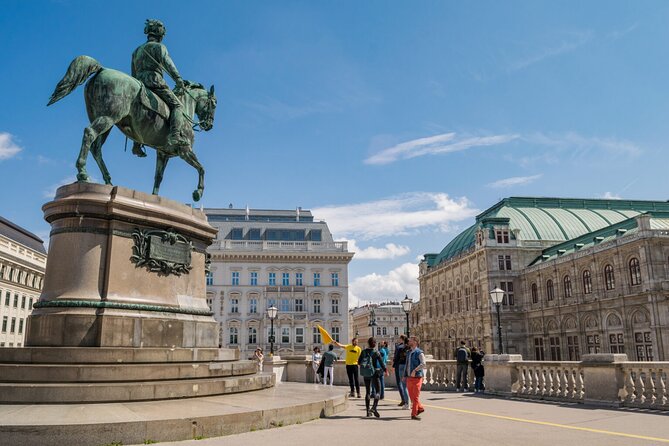
Next comes Heldenplatz, with impressive monuments and more history about the square. Heldenplatz is a place where Vienna looks monumental and formal. A guided explanation helps you read the space instead of just walking through it quickly.
One consideration: the timing is short at these center stops. If your dream is to linger over building details, carvings, and church facades until your camera battery dies, you may wish there were extra time for pure sightseeing. This tour is designed more for big-picture orientation than for slow, obsessive architecture time.
Still, for a first day, you get two anchor points you can build your itinerary around. After you leave, you will know where the Hofburg area fits and how Heldenplatz sits in the broader old city map.
Kahlenberg: panoramic payoff and the real downhill thrill
After the practice setup, the tour moves into the headline descents. One major destination is Kahlenberg, the wooded hill north of Vienna. You get the chance to see Klosterneuburg Monastery and enjoy panoramic city views before you descend.
This section is the reason you sign up if you want more than a walking tour. The roads are coiled around the slopes, and the view is part of the experience, not just a background. As you ride down, you will feel the speed kick in, then learn when the guide expects you to slow and set up for sharp bends.
A practical way to enjoy this: keep your attention up. Downhill riding on any two-wheeler is not about checking your phone or taking photos in the middle of the curve. If you want the thrill and the safety, look ahead, follow the pacing cues, and let the ride unfold.
Exelberg and the vineyard slopes: second descents with scenery
You then continue with two other downhill rides. One includes the Exelberg area, where hillsides are coated in leafy urban vineyards. This is a different visual vibe than the straight city views. You are cruising through greenery and slopes that make Vienna look like it spills into the countryside.
The roads are steep and snaking, so you are still doing careful corner negotiation. That is part of the fun, and also part of why the practice run is so important. By the time you hit these later descents, you are more likely to feel in control rather than just going along for the ride.
The overall rhythm stays consistent. There is a pause when you need instruction or regrouping, then momentum resumes. You finish back in central Vienna with a drop-off at the original start area or the nearest subway station.
Guides, pacing, and why storytelling matters here
A scooter ride can be just a ride. What makes this one feel like a true Vienna experience is the guide’s narrative glue. When the guide is a strong storyteller, you understand what you are seeing while you are moving, and that makes the time feel tighter in the best way.
I like that you can feel this tour’s emphasis on orientation, not just motion. In the guidance I have seen from this kind of experience, Michael has a reputation for giving a great first-day sense of where things are, and Katharina is known for keeping the experience flowing so the two hours move fast. That matters because you are juggling gear, instructions, and descents in one tight loop.
Also, the stops are positioned so you do not just fly past landmarks. Passing the Hofburg and stopping at Heldenplatz gives you a framework for your next visits, so you can later connect the palace complex and monumental square to the rest of Vienna’s old city.
Price and value: why this cost can make sense
The price is $22.83 per person, for roughly two hours. On its own, that might sound high compared with classic free walking tours. But here, the value is not only the guide talk.
You are paying for several concrete pieces:
- Transport by air-conditioned minivan
- Prater area walking plus the switch to scooter activity
- A helmet and structured practice time
- Multiple downhill rides, including Kahlenberg and the Exelberg area
For many visitors, that is exactly the tradeoff they want. You are not buying museum tickets or long rail transfers. You are buying energy and perspective, plus gear and supervision so you can safely try something you probably would not set up on your own on a tight schedule.
Tips are not necessary, but more than welcome. If you get good instruction and a smooth ride, tipping feels like an easy way to reward the work that keeps the group safe and moving.
One more practical note: the average booking window is about 8 days in advance, so if your dates are fixed, planning ahead can help you avoid sold-out slots.
Who this tour fits best (and who should skip it)
This works best for:
- First-time Vienna visitors who want orientation plus a memorable viewpoint
- People comfortable with an active plan, including scooter practice and downhill riding
- Travelers who like city history, but do not want a slow, sit-and-stare format
- Anyone who wants to escape the noise of the center for a scenic hillside ride, then return quickly
It may not fit as well if:
- You strongly prefer long stops for close-up architecture photos and deep museum time
- You are very sensitive to cold or wind, since it runs in all weather conditions and descents can feel brisk
- You want a purely “walking only” tour, because scooters are the star of the show
Practical tips so you enjoy every part
Because the tour operates in all weather, dress appropriately. If it is cold, the descents can feel colder once you are moving faster. If it is wet, you will still ride, so plan for that reality rather than hoping weather will change.
Also, come ready to follow guidance. Downhill riding depends on your attention and how well you follow instructions for speed and cornering. If you treat the practice ride seriously, you will get a far more confident experience on the later sections.
And since the tour ends near St. Stephen’s Cathedral, it is easy to tack on your own dinner and final wandering afterward, without having to think about transport.
Should you book Walking Tour Vienna with downhill scooters?
If you want a one-session Vienna crash course plus a real viewpoint reward, I would lean yes. The combination of center orientation (Hofburg and Heldenplatz) with Kahlenberg panoramas and Exelberg vineyard scenery is a rare mix, and the structured scooter practice plus helmet support makes it feel more approachable than it sounds.
If you are mainly chasing quiet, slow history in front of specific buildings, you might prefer a more walking-focused history route. But if you want Vienna with motion, speed, and a clearer map in your head afterward, this is a very good use of a short stay.
FAQ
How long is the Walking Tour Vienna experience?
It runs for about 2 hours.
What is the price per person?
The price is $22.83 per person.
Is the tour offered in English?
Yes, it is offered in English.
Where do I meet for the tour?
You meet at Helmut-Zilk-Platz, Albertinapl 2-3, 1010 Wien, Austria.
Where does the tour end?
It ends at St. Stephen’s Cathedral area, Stephansplatz 3, 1010 Wien, Austria, with about a 1 to 2 minute walk distance to Stephansdome.
Do I get a helmet and practice before the downhill rides?
Yes. You are supplied with a helmet and you have a practice ride before the faster downhill sections.
How fast can the scooters go?
The downhill ride can reach speeds of up to 39 miles per hour (64 kph).
Does the tour run in all weather?
Yes, it operates in all weather conditions, so you should dress appropriately.
Is tipping required?
No, tips are not necessary, but they are more than welcome.
What if I need to cancel?
You can cancel for a full refund up to 24 hours in advance. If you cancel less than 24 hours before the start time, the amount paid is not refunded. If the tour is canceled because a minimum number of travelers is not met, you will be offered a different date or a full refund.
Walking Tours: Rest of the Austria File
- Vienna: Guided Walking Tour of City Center Highlights
★ 4.7 · 4,989 reviews - Vienna: Vienna Central Cemetery Guided Walking Tour
★ 4.8 · 3,307 reviews - Vienna: Guided Walking Tour of City Highlights & Hidden Gems
★ 4.9 · 2,180 reviews - Vienna: Viennese Underworld Guided Walking Tour
★ 4.7 · 1,865 reviews
Tours: Rest of the Austria File
- Vienna: Schönbrunn Palace & Gardens Skip-the-Line Tour
★ 4.7 · 7,739 reviews - Vienna Spanish Riding School Guided Tour
★ 4.7 · 6,765 reviews - Vienna: Skip-the-Line Sisi Museum, Hofburg and Gardens Tour
★ 4.8 · 5,918 reviews - Vienna: Skip-the-Line Schönbrunn Palace & Gardens Tour
★ 4.8 · 5,411 reviews
Tour Reviews: Rest of the Austria File
- Vienna: Vivaldi’s Four Seasons Concert in Karlskirche
★ 4.7 · 14,951 reviews - Vienna: Schönbrunn Palace & Gardens Skip-the-Line Tour
★ 4.7 · 7,739 reviews - Vienna: Light of Creation Votive Church Immersive Light Show
★ 4.8 · 6,779 reviews - Vienna Spanish Riding School Guided Tour
★ 4.7 · 6,765 reviews
Newest Vienna write-ups on file
- Vienna: Private Walking Tour to The Hofburg & Graben Street★ 5.0 · 3 reviews
- Vienna: Private tour Mauthausen and Linz★ 4.1 · 3 reviews
- Vienna Private Full Day Tour – Tickets to Schönbrunn & Lunch★ 5.0 · 3 reviews
- Vienna: Johann Strauss 200th birthday anniversary exhibition★ 4.7 · 3 reviews
- Vienna: Full-Day Vienna Woods Wine Tasting Tour★ 5.0 · 3 reviews
- Vienna: Festive Season and New Year’s Eve Waltz Workshop★ 5.0 · 3 reviews
Walking Tours, compared.
 ★ 4.7Vienna: Guided Walking Tour of City Center HighlightsFrom $254,989 reviews
 ★ 4.8Vienna: Vienna Central Cemetery Guided Walking TourFrom $3353,307 reviews
 ★ 4.9Vienna: Guided Walking Tour of City Highlights & Hidden GemsFrom $272,180 reviews
 ★ 4.7Vienna: Viennese Underworld Guided Walking TourFrom $371,865 reviews
 ★ 4.8Vienna: World War II Historical Walking TourFrom $311,772 reviews
 ★ 5.0Vienna Historic Center Small Group Walking TourFrom $721,746 reviews
 ★ 4.6Vienna: Private Walking Tour with a Local GuideFrom $551,420 reviews
 ★ 4.9Vienna: 1.5-Hour Underground Walking TourFrom $321,146 reviews
This tour also sits in