
REVIEW · CITY TOURS
Terrible crimes in Vienna, hidden secrets of the inner city
Vienna can be creepy, in the best way. This offbeat walking tour uses notorious crimes to guide you through the inner city you thought you already knew, from monastic dungeons to political violence. Just know the stories can get pretty grim, so it is not for everyone.
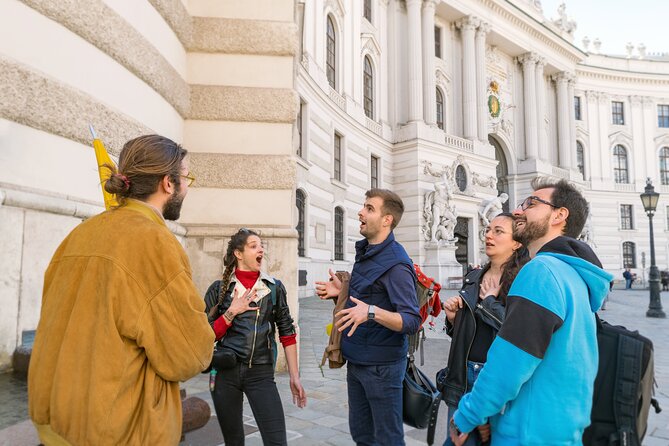
What I like most is how the tour ties dark events to real places you can stand on today. I also like the way the route feels tightly paced, and how your guide Ben brings the material to life with stories that connect century to century and keep you moving toward the next stop.
In This Review
- Key highlights before you go
- How a 2-hour Vienna true-crime walk actually feels
- Start at Albertina area, then shift into the dungeon mindset
- Stop 1: Tegetthoffstraße 2 and the Capuchin Monastery dungeon
- Stop 2: Trattnerhof and the Jaroszynski murder case
- Stop 3: Palais Bathory at Augustinerstraße 12, blood-countess legend
- Stops 4 to 6: Demel, Ferstel, and Hotel Klomser, three centuries of greed and power
- Palais Ferstel and “Zu den Fünf Morden”
- Colonel Redl and the Hotel Klomser
- Stops 7 to 10: Molker Bastei, 1848 violence, and punishments that fit the business model
- Hannaken-Brunnen and the surgeon who engineered injuries
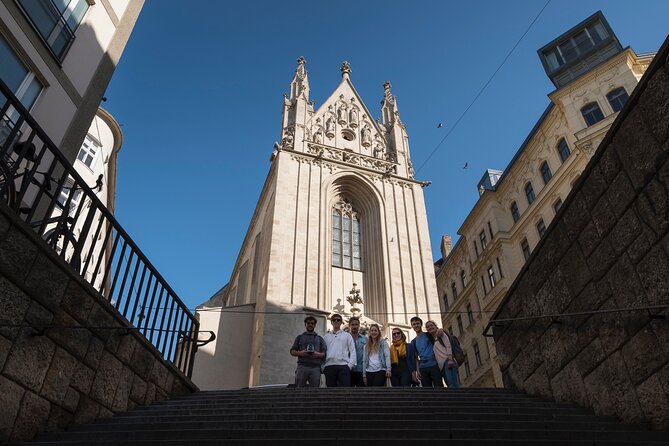
- Maria Am Gestade and the last wheel execution in Vienna
- Stops 11 to 13: Hoher Markt torture, St. Stephen’s baker punishment, and Vienna’s one witch trial
- Stop 14: Himmelpfortgasse and the nun walled in during 1319
- Who this tour is for, and who should skip it
- Should you book this Vienna crime-and-history walk?
- FAQ
- How long is the tour?
- Is the tour offered in English?
- Do I get a mobile ticket?
- Is there a smartphone audio guide included?
- Where does the tour start?
- Where does the tour end?
- What is the group size limit?
- Does the tour depend on weather?
- What is the cancellation window?
Key highlights before you go
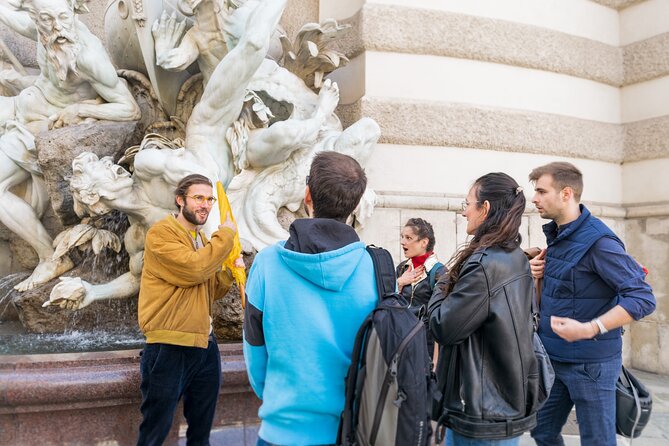
- A crime story for nearly every corner of Vienna’s historic center, not a random collection of spooky facts
- Complimentary smartphone audio guide, so you can follow along even while the group walks
- All stops are listed as admission ticket free, so your $46.13 price is mostly for the experience
- Guided in English with a small group size, max 20 people
- A real walking route through older inner-city buildings, including remnants of Vienna’s city wall
Other Vienna write-ups filed under Austria
- Vienna: Guided Walking Tour of City Center Highlights
★ 4.7 · 4,989 reviews - Vienna: City Cruise with Optional Lunch
★ 3.4 · 3,982 reviews - Vienna: City Cruise
★ 3.3 · 2,978 reviews - Vienna: Guided Walking Tour of City Highlights & Hidden Gems
★ 4.9 · 2,180 reviews
How a 2-hour Vienna true-crime walk actually feels
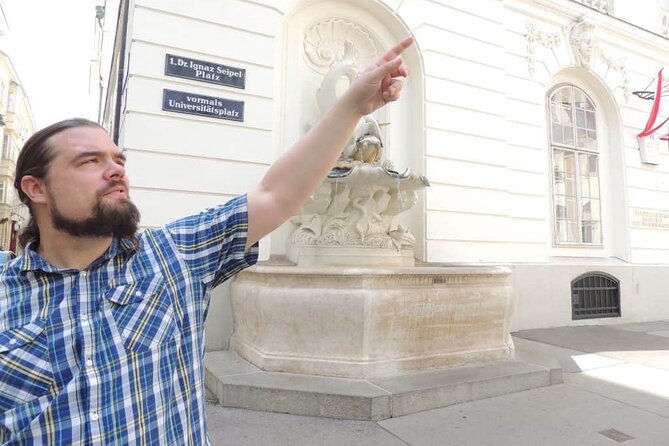
This is a short, high-energy way to see the inner city. The whole experience runs about 2 hours and moves through a chain of specific addresses and street landmarks. Most stops are only 5 to 15 minutes, which means you are getting quick context, then stepping forward to the next location.
The stories are not just modern sensationalism. They span centuries, so you end up seeing how Vienna’s ideas about punishment, power, crime, and superstition changed over time. You start near the Albertina area and finish at Rauhensteingasse, so the walk stays anchored in the core of the city.
Cost-wise, $46.13 per person can feel reasonable for what you get: a guided route through many distinct stops, an included smartphone audio guide, and the stops are listed as admission ticket free. For travelers who want more than a two-hour stroll but do not want to build a whole museum day around their schedule, this is a strong value.
One small caution: because the tour focuses on murder, torture, executions, and alleged serial-killer myths, you should go in with the right expectations. If you are sensitive to graphic themes, you may want to skip it or choose a lighter walking option.
Start at Albertina area, then shift into the dungeon mindset
The meeting point is Helmut-Zilk-Platz (Albertinapl. 2-3, 1010 Wien). That choice matters. You begin in a central area where you can easily orient yourself, then the tour swings you toward darker, less tourist-famous corners.
At the start, you have both a live guide and a smartphone audio guide to support what you are hearing. That makes a difference with story-based tours. Instead of trying to remember everything in a single stream of speech, you can track the narrative as it shifts from place to place.
You are also walking with a relatively small group, up to 20 people, which tends to keep the pace interactive and helps the guide manage questions. The tour is offered in English, so you can follow the details without guesswork.
Stop 1: Tegetthoffstraße 2 and the Capuchin Monastery dungeon
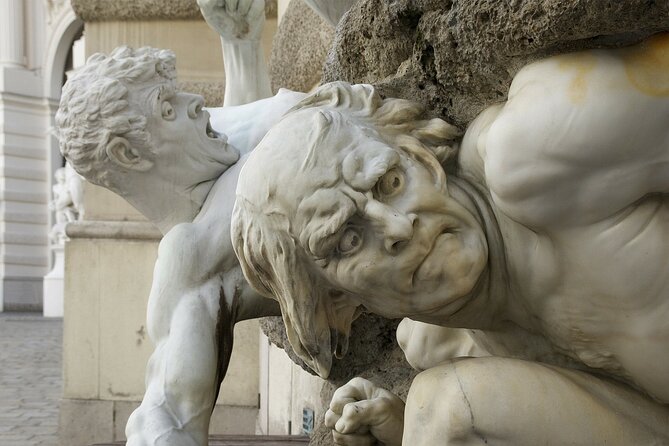
Your first big jolt comes at Tegetthoffstraße 2, at the Capuchin monastery. This is where the tour leans hard into the theme of punishment behind religious walls.
You hear about Father Innocentius and a monastery dungeon where monks were sometimes locked up for decades. The reasons given are partly absurd by modern standards, including unauthorized afternoon walks and even one-time abuse of monastery officials. This stop is not just a scary setting. It shows you how authority could become personal, arbitrary, and long-lasting.
The story then connects the monastery to the state. Father Innocentius announced the dungeon to Emperor Joseph II, who closed it and transferred Innocentius to Lviv for his safety. Later, Innocentius reportedly became Protestant, a Freemason, and an advisor to the tsar. It is a wild personal arc, and it also hints at how dangerous it could be to challenge power.
What to watch for here: the tour is building a pattern. Vienna’s inner-city “quiet” spaces often had hard machinery behind the scenes. If you like history that explains how people were controlled, this stop lands well.
Stop 2: Trattnerhof and the Jaroszynski murder case
Next you move to Trattnerhof, tied to the Jaroszynski murder case. This is one of the tour stops that reads like both true crime and cultural history, because it highlights how fame can get dragged into wrongdoing.
The case is best known for the involvement of actress Therese Krones. She is drawn into the murder plot despite having little connection, and her career is destroyed. Then you get the rumor version of events: claims that Jaroszynski’s despair came from extravagant desires.
The tour’s balance point is the reality angle. Jaroszynski is described as addicted to games and heavily in debt. That shift, from spectacle to motive, is why this tour works for history-minded travelers. It does not only tell you what happened. It also tells you how stories get twisted by rumor.
The practical drawback is that this stop is brief, and the story is morally messy. If you prefer clean moral lines, you may find the overlap between public scandal and real motive unsettling.
Stop 3: Palais Bathory at Augustinerstraße 12, blood-countess legend
At Augustinerstraße 12, you reach Palais Bathory, associated with Elisabeth Bathory, often called the blood countess. This stop is a mix of legend, reputation, and court intrigue, and the tour makes clear that the story can be read two ways.
On one side, the famous allegation is that Bathory murdered more than 600 virgins and bathed in their blood to keep or enhance youth and beauty. On the other side, the tour frames a competing possibility: she might have been the target of violent intrigue tied to a countess whose loyalty needed removing.
That balanced framing is useful. It helps you see why these tales persist, even when the facts are hard to separate from propaganda and fear. It also keeps the tour from turning into pure shock.
If you are hoping for a fully documented courtroom-style explanation, this stop may feel more like a controlled story presentation than an academic verdict. But as a “how myths attach to places” lesson, it’s strong.
Stops 4 to 6: Demel, Ferstel, and Hotel Klomser, three centuries of greed and power
The heart of the route gets sharper when you reach the area of Graben and Kohlmarkt, around Place of the Demel. Here the tour links a modern-feeling scandal to a very recognizable city landmark.
You hear about the Udo Proksch era in the 1970s, and the Lucona affair. A far overinsured freighter was chartered for Asia, and an explosive charge was hidden on board. The conspiracy led to mass murder and massive insurance fraud. The investigation took years, in part because Proksch had relationships in many directions.
This stop does something clever: it shows that crime is not only old. It just changes costumes. The inner city setting makes the scandal feel close enough to be real, not distant.
Palais Ferstel and “Zu den Fünf Morden”
Then you head to Herrengasse and Palais Ferstel, the former location of the house known as Zu den Fünf Morden. The site is tied to one of medieval Vienna’s most notorious mass murders.
You learn that the perpetrator was impaled because the deed, including murders of children as young as seven, was judged uniquely terrible. And then comes a grim procedural detail: the executioner was not experienced with this type of execution, so the process took extremely long.
This stop is intense because it shows how the justice system made punishment part of the message. It also gives you a sense of why medieval Vienna could feel brutal even when the architecture looks elegant.
Colonel Redl and the Hotel Klomser
Opposite Palais Ferstel, you stop at the former Hotel Klomser, tied to Colonel Redl. His suicide is framed as the end point of the monarchy’s biggest spy affair. The story goes further, saying the affair could have been a decisive factor for the First World War.
The impact mattered internally too. Discovering Redl’s espionage activity damaged the army’s reputation and exposed the vulnerability of the underfunded Evidenzbureau secret service.
This is where the tour’s theme expands again: from public punishment to state secrets. If you like history where crime and power are inseparable, you will enjoy this part.
Stops 7 to 10: Molker Bastei, 1848 violence, and punishments that fit the business model
At Molker Bastei, the tour moves into the Anna Gaugisch murder case. In 1861, she is described as being dismembered by her boyfriend Raimund Lewisch, and parts of her body are said to have been found in the Danube and in the water location near the stop.
The motive is framed in practical, ugly terms: Lewisch is portrayed as wanting to remove an uncomfortable situation, including the fact that she was pregnant. The location gives the story a physical edge, because you are literally in a spot tied to the waterways involved.
Next you go to Am Hof, where the focus becomes political violence. The tour describes the lynch murder of war minister Theodor Baillet de Latour during the revolution year 1848. It is presented as one of the rare cases of political violence in Vienna, and also as the beginning of the Wiener October Revolution, later remembered for the more violent end section.
You also hear about the civil arsenal being in the same area, and that it was looted during the revolution. This stop makes the point that crime is sometimes collective, not only individual.
Hannaken-Brunnen and the surgeon who engineered injuries
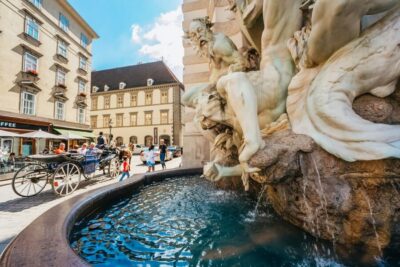
At Hannaken-Brunnen, the story turns almost darkly entrepreneurial. You hear about Hannakenkönig, a surgeon who caused broken bones himself to improve business.
The method described is cruelly simple: he set trip hazards to provoke injuries, then healed the victims afterward. The fountain itself shows two men carrying an injured comrade to the surgeon, which makes the story feel like street art turned into a warning.
You also learn the Hannaken were a minority in Moravia who often looked for work in Vienna. That social detail matters because it situates the crime inside a pattern of migration and labor, not just a random horror case.
Maria Am Gestade and the last wheel execution in Vienna
At Maria Am Gestade, you reach a section of city wall connected to the Zahlheim case. The tour frames it as the last wheeling execution in Vienna, a death penalty described as extremely cruel.
The Joseph II angle is the part you will likely remember. Joseph II is said to usually reject the death penalty, but the case forced a change. This stop gives you a sharp example of how even a ruler’s moral stance could be overridden by a particular set of facts, not by ideas alone.
Stops 11 to 13: Hoher Markt torture, St. Stephen’s baker punishment, and Vienna’s one witch trial
At Hoher Markt, the tour includes the story of Thekla Riener. She is described as being tortured here, and the account says she was supposed to betray a supposed lover. The twist is that the lover is described as not existing at all, and the entire sequence is framed as a chain of insane acts driven by jealousy of imaginary lovers.
This is not “mystery murder” in the modern detective sense. It is a story about obsession, imagination, and the way people can harm each other while believing they are acting on something real.
Then you reach the area tied to St. Stephen’s Cathedral legends. The tour explains the “baptism of bakers” punishment associated with a medieval idea of brutal quality assurance. The true part of the legend, as told here, is that bad bakers were put into a cage and dipped several times into the Danube.
Even if you are skeptical about legends, the point is cultural. It shows what society once considered acceptable enforcement for something as ordinary as bread quality. You are in Vienna’s most famous cathedral area, but the story yanks you away from postcards and into old ideas of punishment.
Finally you go to Steffl and the former Malefizspitzbubenhaus, tied to an executioner’s apartment and dungeon. This stop includes the claim that the Plainacher was the only witch burned in Vienna, after being charged with bewitched an epileptic granddaughter and summoning demons.
It also notes witch persecutions were not common in Vienna, and that the city judge had to avoid public pressure. That detail gives you a social angle. Even fear can depend on who holds the crowd.
Stop 14: Himmelpfortgasse and the nun walled in during 1319
You end at Himmelpfortgasse, formerly connected to the Himmelpfort monastery. Here you hear about a nun walled in during 1319 because she did not want to part with a lover her father hated.
The comparison used is basically a Viennese version of Romeo and Juliet: family conflict, rival forces, and a forced life path. The tour frames it as a mayor and his archenemy with children who are good friends, and when the mayor’s son asks for the nun’s hand, her father condemns her to a life as a nun.
This final stop lands differently than the executions and dungeons. It is about control through confinement and family power, not only state violence. It also helps the tour close its loop: across centuries, the inner city keeps repeating the same basic question. Who gets to choose someone else’s fate?
Who this tour is for, and who should skip it
This works best for you if you like:
- True crime stories that are tied to real locations, not just generic facts
- History that connects to architecture and street-level details
- A paced walking route that keeps momentum, with quick stops that each add a new century
It is not ideal if:
- You dislike grim topics like torture, executions, dismemberment, and violent legends
- You want a light sightseeing day with minimal emotional weight
Also, based on what is included, you are getting more than a lecture. You get the complimentary smartphone audio guide plus a guided route in English. The tour is small, max 20, which helps the storytelling feel like an actual experience rather than a shuffle.
Should you book this Vienna crime-and-history walk?
If you want Vienna beyond the usual highlights, this is a smart pick. The value sits in the combination: $46.13 for about 2 hours, a guided story route through the inner city, and a free smartphone audio guide, while the stops are listed as admission ticket free.
I would book it if you are curious about the darker side of Vienna and like learning through narrative. I would skip it if you are easily disturbed by violent material or you prefer history that stays comfortably polite.
FAQ
How long is the tour?
It runs for about 2 hours.
Is the tour offered in English?
Yes, it is offered in English.
Do I get a mobile ticket?
Yes, the experience includes a mobile ticket.
Is there a smartphone audio guide included?
Yes, you get a complimentary smartphone audio guide.
Where does the tour start?
The meeting point is Helmut-Zilk-Platz (Albertinapl. 2-3, 1010 Wien).
Where does the tour end?
The tour ends at Rauhensteingasse, 1010 Wien.
What is the group size limit?
The tour has a maximum of 20 travelers.
Does the tour depend on weather?
Yes, it requires good weather.
What is the cancellation window?
You can cancel up to 24 hours in advance for a full refund.
City Tours: Rest of the Austria File
- Vienna: Guided Walking Tour of City Center Highlights
★ 4.7 · 4,989 reviews - Vienna: City Cruise with Optional Lunch
★ 3.4 · 3,982 reviews - Vienna: City Cruise
★ 3.3 · 2,978 reviews - Vienna: Guided Walking Tour of City Highlights & Hidden Gems
★ 4.9 · 2,180 reviews
Tour Reviews: Rest of the Austria File
- Vienna: Vivaldi’s Four Seasons Concert in Karlskirche
★ 4.7 · 14,951 reviews - Vienna: Schönbrunn Palace & Gardens Skip-the-Line Tour
★ 4.7 · 7,739 reviews - Vienna: Light of Creation Votive Church Immersive Light Show
★ 4.8 · 6,779 reviews - Vienna Spanish Riding School Guided Tour
★ 4.7 · 6,765 reviews
Newest Vienna write-ups on file
- Vienna: Private Walking Tour to The Hofburg & Graben Street★ 5.0 · 3 reviews
- Vienna: Private tour Mauthausen and Linz★ 4.1 · 3 reviews
- Vienna Private Full Day Tour – Tickets to Schönbrunn & Lunch★ 5.0 · 3 reviews
- Vienna: Johann Strauss 200th birthday anniversary exhibition★ 4.7 · 3 reviews
- Vienna: Full-Day Vienna Woods Wine Tasting Tour★ 5.0 · 3 reviews
- Vienna: Festive Season and New Year’s Eve Waltz Workshop★ 5.0 · 3 reviews
City Tours, compared.
 ★ 4.7Vienna: Guided Walking Tour of City Center HighlightsFrom $254,989 reviews
 ★ 3.4Vienna: City Cruise with Optional LunchFrom $383,982 reviews
 ★ 3.3Vienna: City CruiseFrom $382,978 reviews
 ★ 4.9Vienna: Guided Walking Tour of City Highlights & Hidden GemsFrom $272,180 reviews
 ★ 4.7Vienna: City Sightseeing Tour in an Electro Vintage CarFrom $1161,085 reviews
 ★ 3.5Skip-the-Line Schonbrunn Palace Guided Tour and Vienna Historical City TourFrom $82940 reviews
 ★ 3.5Vienna Hop On Hop Off City TourFrom $42884 reviews
 ★ 4.1Salzburg: Hop-on Hop-off City TourFrom $35720 reviews
This tour also sits in